


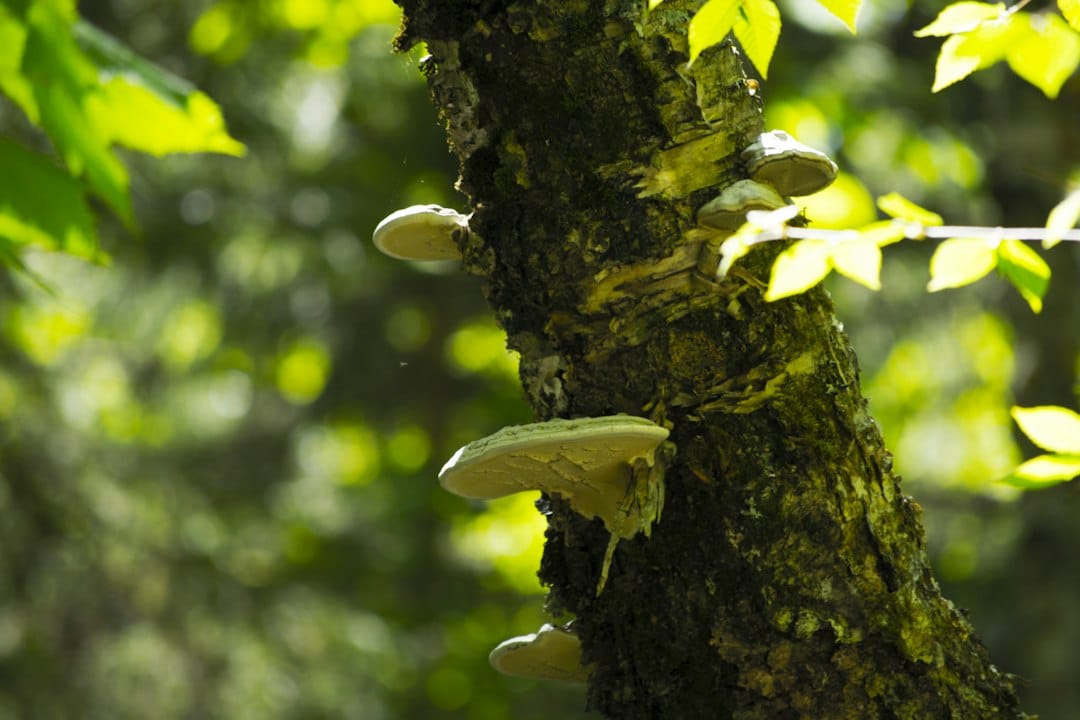
Mushrooms near a tree trunk often appear after warm, wet weather. Some grow from mulch or buried wood and have little to do with the living tree. Others may be connected to decaying roots, an old stump, or damaged wood inside the trunk. The mushroom is only the visible fruiting body, so its location and the tree’s overall condition matter more than its size alone.
Finding mushrooms does not automatically mean a tree must be removed. It does mean the area deserves a closer look, especially when the tree is large or close to a home, driveway, sidewalk, or play area.
Mushrooms may be feeding on organic material
Fungi play an important role in breaking down dead material. Mushrooms can emerge from wood chips, buried construction lumber, old roots, or a stump left beneath the soil. If they are scattered through a mulched bed and not attached to the tree, they may be decomposing material in the landscape.
Even so, avoid eating or handling unknown mushrooms unnecessarily. Identification from a casual photograph can be difficult, and different species may look similar.
Growth at the trunk or root flare deserves attention
Mushrooms growing directly from the trunk, a major root, or the point where the trunk meets the soil can indicate that fungus is using decayed wood. Decay can reduce the strength of roots or the lower trunk without creating an obvious hollow that a homeowner can see.
The tree may still have green leaves and appear healthy above ground. Foliage shows that water is moving through the tree, but it does not prove the supporting wood is sound. Structural condition and biological health are related, yet they are not the same thing.
Look for other changes around the tree
Note whether the mushrooms return in the same location, appear in a ring, or emerge after every period of rain. Check for cracks, loose bark, cavities, sawdust-like material, damaged roots, or soil lifting on one side. A new lean or a recent change in the ground around the base should be treated seriously.
Also look upward. Dead branches, a thinning canopy, unusually small leaves, or early color can provide additional clues. None of these signs confirms the cause by itself, but the combination helps an arborist decide what to inspect next.
Do not simply remove the mushrooms and assume the issue is gone
Picking a mushroom removes the visible structure, not the fungal network in the wood or soil. Spraying the area is unlikely to restore decayed structural wood. If decay is present, the key questions are how much wood is affected, where it is located, and what would be struck if the tree or a major part failed.
An assessment may include sounding the trunk, examining cavities and root flare, reviewing site changes, and considering the species and history of the tree. Additional testing may be recommended when the consequences of failure are high.
Reduce avoidable stress around the roots
Protect the root zone from trenching, repeated vehicle traffic, and deep soil or mulch. Keep mulch in a broad, shallow layer and away from direct contact with the trunk. Do not cut surface roots simply because they are visible. Root damage can create entry points for decay and reduce the tree’s stability.
If a tree is determined to be hazardous and cannot be managed through pruning or monitoring, professional tree removal may be the appropriate option. Large trees near structures often require careful rigging or crane support.
Schedule an evaluation when the setting raises concern
Tree Service of Troy evaluates trees throughout Troy and Oakland County. We can look at the mushrooms in context, inspect visible defects, and explain whether monitoring, pruning, or removal should be considered.
Call (855) 648-7337 or request a free written quote if mushrooms are appearing at the base of an important tree.
Document what appears and when
Photograph mushrooms before they dry out or are removed, including a wide image showing their exact location relative to the trunk. Note recent rainfall, lawn irrigation, excavation, and any changes in the tree’s lean or canopy. If the growth returns, record the date and location again. This history can help a professional distinguish a one-time flush in mulch from repeated fruiting associated with buried roots or decayed wood.