


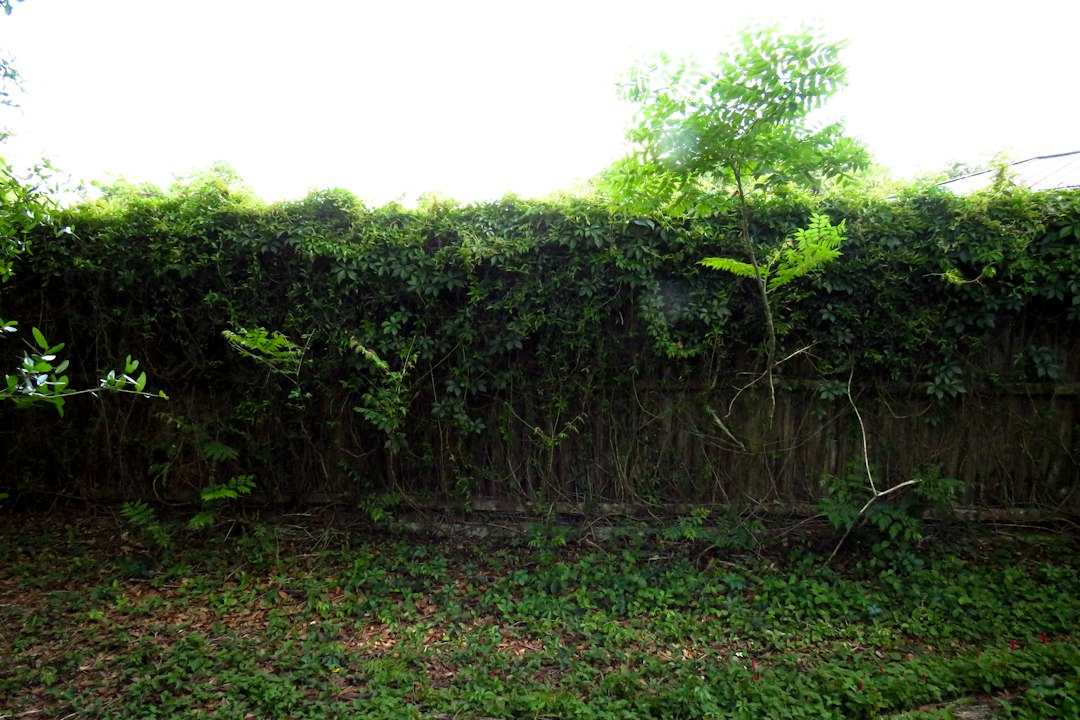
A tree that appears on its own can be welcome in the right place. Along a fence, under a utility line, or inches from a garage, the same seedling can become a long-term conflict. These self-seeded plants are often called volunteer trees because no one intentionally planted them.
Removing a volunteer while it is small is usually simpler and less disruptive. Once the trunk thickens and roots spread beneath fences or hardscape, the job requires more planning.
Why volunteer trees appear
Seeds arrive by wind, birds, squirrels, and runoff. Maples, mulberries, elms, boxelders, and other locally common trees can establish in neglected corners where mowing does not reach. Fence lines are especially favorable because leaves and moisture collect there and seedlings are protected from routine lawn equipment.
Not every volunteer needs to go. A well-positioned native tree may add shade and habitat. The decision should be based on species, mature size, condition, and location rather than the fact that it was not planted.
Look at the mature tree, not the current seedling
A sapling may fit comfortably in a narrow strip today but eventually develop a broad canopy and substantial trunk. Consider its distance from the house, fence, driveway, overhead wires, and neighboring trees. Also ask whether there is enough open soil for roots and whether the canopy will have room to develop without repeated cutting.
If the only way to keep a tree in place is frequent aggressive pruning, early removal may be the better long-term choice. Replacing it with a species suited to the available space can reduce future maintenance.
Confirm the property line
Trees growing directly on or near a boundary can involve both neighbors. Do not assume the fence marks the exact legal line. Before removing a tree that may be shared, review the survey and speak with the adjoining property owner. Clear communication is far less expensive than a dispute after work begins.
Branches or roots extending across a boundary can also raise legal and practical questions. Professional tree workers can explain the physical work, but property ownership questions may require guidance from the municipality, surveyor, or legal professional.
Protect the fence and surrounding landscape
A tree pressed against a fence cannot always be felled in one piece. Branches and trunk sections may need to be rigged into a controlled drop zone. Panels sometimes need temporary removal to create safe access, and underground utilities should be considered before stump work.
Do not attach pulling equipment to a fence post or use the structure as a rigging point. The goal is to remove the tree without transferring force into the fence, neighboring property, or nearby plants.
Decide what to do with the stump
Cutting the trunk leaves a stump that may resprout, interfere with repairs, or remain trapped in the fence line. Stump grinding can reduce it below grade, but access, metal, utilities, and the exact property boundary affect what is possible. Discuss stump work before the removal quote is finalized.
Brush, logs, and chips should also be part of the plan. Our debris cleanup service can remove the material rather than leaving an unexpected pile along the boundary.
Handle small conflicts before they become large jobs
Tree Service of Troy provides professional tree removal and stump grinding throughout Troy and Oakland County. We can evaluate access, identify obstacles, and explain how a volunteer tree can be removed with minimal disturbance.
Call (855) 648-7337 or request a free written quote before a small boundary tree becomes a major conflict.
Review access from both sides of the boundary
Before scheduling removal, look at gates, overhead wires, garden beds, and neighboring structures on each side of the fence. A crew may be able to complete the job entirely from your property, or the safest method may require written permission for temporary access next door. Confirm who will protect or move fence panels, where branches will be lowered, and how the work area will be cleaned. Planning these details before the appointment prevents delays and helps preserve a good relationship with the neighbor while the tree conflict is resolved.